The Saudi Arabia Flag: A Timeless Symbol of Faith, Unity, and National Identity
The flag of Saudi Arabia stands as one of the most instantly recognizable national symbols in the world. Its distinctive green color, sacred Islamic inscription, and bold white sword combine faith, history, and national pride into a single, powerful image. Yet beyond its visual beauty lies a deep and layered story of cultural identity, tradition, and meaning that stretches back over three centuries.
In this in-depth article, we will explore the history, design, symbolism, cultural significance, and unique characteristics of the Saudi Arabia flag. By the end, you will understand why this flag is not only a banner of a nation but also a declaration of enduring faith and unity.
1. The Historical Journey of the Saudi Arabia Flag
The story of the Saudi Arabia flag begins long before the formation of the modern Kingdom. Its origins trace back to the early 18th century during the establishment of the First Saudi State (1744–1818) in the Arabian Peninsula.
At that time, the region was undergoing great political and religious transformation. The Al Saud family, led by Muhammad bin Saud, allied with Islamic reformer Sheikh Muhammad ibn Abd al-Wahhab, forming a partnership that would influence the nation’s identity for centuries. The green banner used during that period bore the Islamic declaration of faith (the shahada), reflecting the core principle of Islam that became central to the emerging state.
As the Saudi state evolved through three historical phases — the First, Second, and finally the Third Saudi State under King Abdulaziz Ibn Saud, the flag evolved with it. When Abdulaziz unified the regions of Najd and Hejaz in 1932 to form the modern Kingdom of Saudi Arabia, the flag became a symbol of the unification process and national sovereignty.
The flag’s design underwent several refinements between 1932 and 1973, including changes in the placement of the sword, the proportions of the text, and the overall dimensions. On March 15, 1973, King Faisal officially approved the design that remains in use today.
This modern version continues to embody the rich spiritual and historical legacy that shaped the Kingdom.
2. The Design of the Flag
Green as a Symbol of Faith and Renewal
The flag’s green background is more than a decorative choice — it carries deep meaning. Green is widely regarded in Islamic culture as a color associated with paradise, peace, and prosperity. It also holds historical significance as the color believed to have been favored by the Prophet Muhammad.
For Saudi Arabia, the color represents the nation’s unwavering commitment to Islam and its role as the birthplace of the faith. The green field serves as a visual reminder that religion is not just part of Saudi identity but its very foundation.
The Sacred Shahada
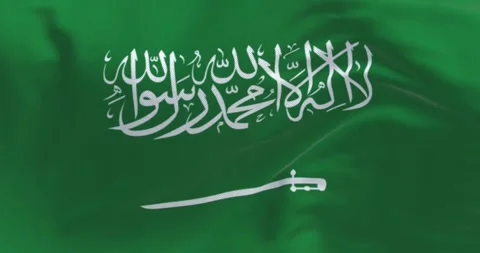
The white inscription at the center of the flag features the shahada, or Islamic declaration of faith, written in elegant Thuluth script:
“There is no god but Allah; Muhammad is the Messenger of Allah.”
This sacred phrase is the most fundamental statement in Islam. Its inclusion on the flag signifies that the Kingdom’s governance and identity are built upon religious devotion.
The shahada also makes the flag unique among world flags — very few other nations display religious text on their national emblem. It serves as a solemn reminder of Saudi Arabia’s role as the spiritual heart of the Islamic world, home to the two holiest cities of Mecca and Medina.
The Sword of Justice and Strength
Beneath the shahada lies a single, horizontal white sword. The sword points to the left (from the viewer’s perspective), symbolizing strength, justice, and the Kingdom’s readiness to defend its faith and sovereignty.
The sword’s inclusion also honors King Abdulaziz Ibn Saud, who led the unification of the Kingdom through strategic and military leadership. In essence, the sword represents courage and the commitment to truth and justice — two values central to Saudi national identity.
Proportions and Design Specifications
The official proportions of the flag are 2:3 (height to width). The text and sword are placed with precise measurements, ensuring balance and symmetry. The white color of both elements contrasts sharply against the deep green background, enhancing legibility and harmony.
The calligraphy style, Thuluth script, is known for its flowing lines and refined elegance, adding both spiritual and artistic depth to the flag’s appearance.
Unlike many other national flags, the Saudi flag has identical front and back sides — the shahada must read correctly from both directions. This is a unique manufacturing requirement, ensuring that the sacred text is never displayed in reverse.

3. Protocol and Respect for the Flag
Because the flag contains the Islamic creed, it must be treated with the utmost respect and care. Saudi law strictly regulates how it can be used and displayed.
Proper Handling and Display
The flag is raised proudly on national buildings, public institutions, embassies, and during major national events such as Saudi National Day (September 23) and Flag Day (March 11).
Unlike most other flags around the world, the Saudi Arabia flag is never flown at half-mast, even during periods of mourning. Lowering it would be seen as an act of disrespect to the sacred shahada.
Furthermore, the flag must never be printed on clothing, used as decoration in a disrespectful way, or placed on items that could be discarded or stepped on. When the flag becomes worn or damaged, it must be properly retired in accordance with official procedures, typically by authorized institutions.
4. The Flag’s Evolution Through History
Early Banners (18th–19th Century)
The first Saudi banners were simple green flags featuring the shahada in white text. Some versions also included a vertical white stripe near the hoist or a pair of crossed swords.
The Formation of the Modern Kingdom (1902–1932)
When Abdulaziz Ibn Saud captured Riyadh in 1902 and began unifying the Arabian Peninsula, he used a green flag with the shahada and a sword beneath it. This design represented both faith and the strength of leadership.
1932 to 1973: Refinement and Standardization
After the official unification of Saudi Arabia in 1932, the flag continued to evolve. Different versions used varying sword designs and proportions. It was not until 1973 that King Faisal approved the standardized version we recognize today.
5. The Meaning Behind Every Element
Each feature of the Saudi flag carries deep symbolism that reflects both national and spiritual principles:
-
Green Background – Represents Islam, peace, life, and renewal.
-
Shahada – Declares the nation’s foundation upon Islamic faith.
-
White Sword – Symbolizes justice, strength, and unity under leadership.
-
No Half-Mast Protocol – Demonstrates reverence for the sacred text.
-
Thuluth Calligraphy – Embodies beauty, balance, and traditional artistry.
Together, these elements make the Saudi flag a visual statement of the country’s religious devotion and sovereignty.
6. The Saudi Flag in Modern Culture
National and International Representation
The Saudi Arabia flag plays a vital role in both domestic celebrations and international representation. It appears prominently during global events such as the Olympic Games, World Cup, and official state visits.
Within the country, it adorns public buildings, schools, and private homes during national holidays. On Flag Day, citizens proudly display the flag to honor their heritage and express unity.
Symbol of National Pride
For Saudis, the flag is not merely a piece of cloth but a living emblem of faith and patriotism. The shahada reminds every citizen of their spiritual duty, while the sword symbolizes resilience and justice.
Public ceremonies often include recitations of the national anthem while raising the flag, creating a powerful emotional connection between the people and their nation.7. The Saudi Flag in Comparison with Other Flags
When compared to other national flags, the Saudi Arabia flag stands apart for several reasons:
-
It is one of very few flags with a religious inscription, making it deeply sacred.
-
It has text that must always be displayed correctly on both sides, a feature almost exclusive to Saudi Arabia.
-
It is never lowered to half-mast, preserving the sanctity of the shahada.
-
It features a weapon (the sword), which is rare among national flags and adds symbolic strength.
These distinctive features make the flag not just unique but deeply meaningful, embodying the Kingdom’s identity in every stitch and stroke.
8. Saudi Arabia Flag Day
In 2023, King Salman issued a royal decree establishing March 11 as Saudi Flag Day. The date commemorates the 1937 decree by King Abdulaziz approving an early version of the modern flag.
Flag Day is now celebrated annually across the Kingdom, with parades, school activities, cultural events, and official ceremonies. The celebration emphasizes the flag’s role in symbolizing unity, justice, and faith — the three pillars of Saudi national identity.
9. Global Perception and Respect
Internationally, the Saudi flag commands a high level of respect due to its sacred text. Foreign embassies and organizations that display it follow strict guidelines to ensure it is handled with dignity.
In sports or diplomacy, Saudi representatives always ensure the flag is presented correctly. It represents not only the Kingdom itself but also the broader Islamic world and its values.
10. Artistic and Cultural Influence
The beauty of the Saudi flag extends beyond its symbolic meaning. The Thuluth calligraphy and balance of form have inspired artists, calligraphers, and designers around the world. Its visual harmony reflects the fusion of faith and art — a hallmark of Islamic aesthetics.
In architecture and fashion, the green and white color scheme often appears in designs celebrating national heritage. The flag’s influence reaches far beyond government buildings; it has become part of Saudi cultural identity and creative expression.
11. The Saudi Flag as a Symbol of the Future
As Saudi Arabia moves forward with Vision 2030 — a bold plan for modernization and development — the flag remains a constant symbol of identity and pride. It connects a rapidly advancing nation to its historical and spiritual roots.
In international contexts, the flag represents not only the Kingdom’s heritage but also its leadership in promoting dialogue, development, and peace. The balance between faith and progress continues to define Saudi Arabia’s image on the global stage.
12. Summary: The Spirit Behind the Green Banner
The flag of Saudi Arabia is much more than a national emblem. It is a visual embodiment of the Kingdom’s history, faith, and unity. Every color, line, and symbol carries meaning that ties the past to the present and guides the country into the future.
From its green field symbolizing faith and renewal to the sacred shahada representing belief, and the white sword symbolizing strength and justice, every element speaks to the soul of a proud nation.
Whether it is flying above the holy cities of Mecca and Medina, displayed in embassies abroad, or held high by Saudi citizens during celebrations, the flag serves as a constant reminder of devotion, unity, and national identity.
It is a banner of faith.
It is a mark of strength.
It is the eternal symbol of Saudi Arabia.