American Mount Rushmore: The Monument That Defines a Nation
Nestled in the heart of South Dakota’s Black Hills, Mount Rushmore stands as one of the most iconic symbols of the United States. It is not just a colossal sculpture carved into the side of a mountain; it is a tribute to the country’s founding principles, leadership, and ambition. The faces of George Washington, Thomas Jefferson, Theodore Roosevelt, and Abraham Lincoln are more than stone portraits. They represent a legacy of determination, freedom, and the American spirit that continues to inspire millions around the world.
Mount Rushmore National Memorial draws over two million visitors each year, who come to witness both its grandeur and the deep sense of history it embodies. But behind the familiar faces and the impressive granite is a fascinating story of vision, artistry, politics, and controversy that spans decades.
In this article, we will explore the history, construction, symbolism, and cultural impact of Mount Rushmore. We will also discuss the controversies surrounding its creation and how it continues to influence American identity in the modern era.
The Vision Behind Mount Rushmore
The story of Mount Rushmore begins in the 1920s with a South Dakota historian named Doane Robinson. He wanted to create a monument that would attract tourists to his state and honor significant figures in American history. His idea was ambitious: to carve the likenesses of famous heroes into the granite cliffs of the Black Hills.
Initially, Robinson envisioned carvings of notable figures from the American West, such as Lewis and Clark, Buffalo Bill Cody, and Lakota leader Red Cloud. However, when sculptor Gutzon Borglum was brought into the project, the vision changed dramatically. Borglum believed the monument should celebrate the birth, growth, and preservation of the United States rather than regional heroes.
After careful deliberation, Borglum selected four presidents—George Washington, Thomas Jefferson, Theodore Roosevelt, and Abraham Lincoln—to represent the nation’s most important ideals. Each man symbolized a crucial chapter in America’s story: Washington for independence and the founding of the nation, Jefferson for expansion and democracy, Roosevelt for industrial growth and conservation, and Lincoln for unity and freedom.
Choosing the Perfect Location
Finding the right location for such an ambitious project was no small task. Borglum and Robinson eventually settled on Mount Rushmore, a granite peak in the Black Hills near Keystone, South Dakota. The mountain had several advantages: it faced southeast, allowing sunlight to illuminate the carvings most of the day, and its granite was strong enough to endure centuries of weather.
The mountain itself was named after Charles E. Rushmore, a New York lawyer who visited the area in the 1880s. Before that, the mountain and the surrounding Black Hills held deep cultural and spiritual significance for the Lakota Sioux, who called the area “Paha Sapa,” meaning “The Black Hills.” This sacred land had been guaranteed to them by the Fort Laramie Treaty of 1868 but was later seized by the U.S. government after gold was discovered there.
This aspect of Mount Rushmore’s history remains one of its most controversial elements, and we will return to it later.
The Monument’s Construction
Construction of Mount Rushmore began on October 4, 1927, and lasted until October 31, 1941. The project was a massive undertaking, requiring the labor of about 400 workers over 14 years.
The carving process was grueling and dangerous. Workers used dynamite to remove large portions of rock and pneumatic drills for the finer details. Despite the hazards, there were no fatalities during construction—a remarkable feat considering the technology and conditions of the time.
Borglum designed the monument to be much larger than it eventually became. He envisioned the presidents’ bodies down to their waists, but funding shortages and the outbreak of World War II forced the project to stop once the faces were complete. Even unfinished, the monument achieved an awe-inspiring level of detail and precision.
Each face measures about 60 feet high, with eyes 11 feet wide and noses about 20 feet long. The entire monument covers 1,278 acres and rises nearly 5,725 feet above sea level.
Symbolism of the Four Presidents
Mount Rushmore is more than an artistic marvel. It is a carefully crafted statement about the ideals that define the United States. Each president was chosen to embody a key principle in the nation’s evolution.
George Washington
As the first President of the United States and the commander-in-chief of the Continental Army, George Washington symbolizes the birth of the nation. His leadership and integrity helped unite the colonies and set the foundation for the democratic government that would follow. Washington’s face occupies the most prominent position on the monument, representing his role as the father of the country.
Thomas Jefferson
Thomas Jefferson represents the expansion of the United States. As the principal author of the Declaration of Independence, he championed liberty and equality. His vision for a growing, prosperous nation was realized through the Louisiana Purchase, which doubled the size of the country. Jefferson’s presence on Mount Rushmore highlights the importance of exploration and opportunity.
Theodore Roosevelt
Theodore Roosevelt symbolizes the development of America as a modern power. Known for his energy and progressive reforms, Roosevelt championed conservation, trust-busting, and social justice. He also oversaw the construction of the Panama Canal, strengthening America’s global influence. His rugged personality and dedication to preserving natural beauty make his placement in the Black Hills particularly fitting.
Abraham Lincoln
Abraham Lincoln represents the preservation of the nation. His leadership during the Civil War ensured that the United States remained a single, united country. Lincoln’s fight to abolish slavery and his belief in equality made him one of America’s most revered figures. His face on Mount Rushmore stands for unity, freedom, and moral courage.
Artistry and Engineering Genius
Gutzon Borglum was not just a sculptor; he was a visionary engineer. He used innovative techniques to achieve the monument’s monumental scale and precision. One of his most remarkable methods involved a process called “pointing,” where large models were scaled up to match the real mountain through a system of measurements.
Workers would hang from harnesses and ropes hundreds of feet above the ground while shaping the rock with drills and dynamite. Borglum’s perfectionism often led him to rework areas until they met his standards.
After Borglum’s death in March 1941, his son, Lincoln Borglum, took over the project. However, with the United States entering World War II later that year, funding and materials became scarce, and work stopped permanently. Despite being unfinished, the monument achieved the grandeur Borglum had imagined.
Mount Rushmore and American Identity
Mount Rushmore quickly became more than a tourist attraction. It evolved into a national symbol of democracy, freedom, and perseverance. During the 20th century, it was featured in countless films, books, and cultural references, including the famous final scene of Alfred Hitchcock’s “North by Northwest.”
For many Americans, Mount Rushmore represents pride and patriotism—a reminder of the country’s achievements and the leaders who helped shape its destiny. It stands as a testament to what the human spirit can accomplish with vision, determination, and unity.
Controversies and Cultural Perspectives
While Mount Rushmore is celebrated as a masterpiece of American art, it is also a deeply controversial monument. The Black Hills region, where the sculpture is located, holds great spiritual significance to the Lakota Sioux. The land was taken from them in violation of the Fort Laramie Treaty, and many Indigenous people view the monument as a symbol of broken promises and colonial intrusion.
From their perspective, carving the faces of American presidents into sacred land—especially leaders who played roles in policies harmful to Native Americans—represents historical trauma rather than national pride.
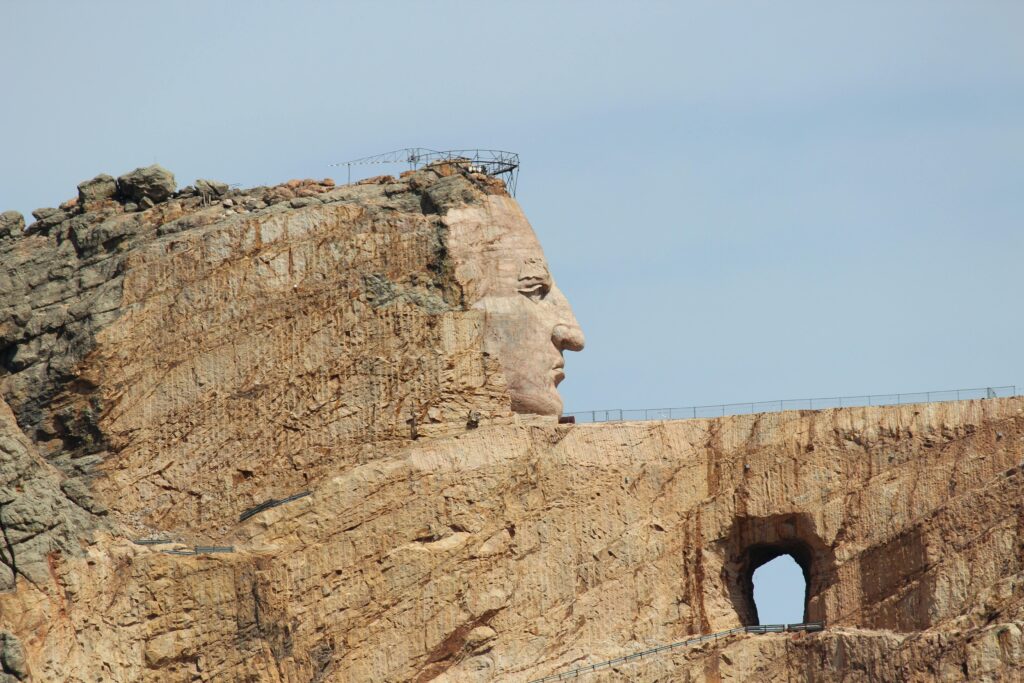
In response to these concerns, there have been movements advocating for the return of the Black Hills to the Lakota people or for more inclusive recognition of Native American history in the area. The nearby Crazy Horse Memorial, begun in 1948 and still under construction today, was created as a Native American response to Mount Rushmore. It honors the Lakota leader Crazy Horse and stands as a symbol of Indigenous pride and resilience.
Tourism and the Mount Rushmore Experience
Today, Mount Rushmore remains one of America’s top tourist destinations. The monument attracts millions of visitors annually who come to experience its beauty and grandeur. The Mount Rushmore National Memorial offers several attractions, including a museum, the Sculptor’s Studio, and scenic walking trails that provide stunning views of the mountain.
The Evening Lighting Ceremony is one of the most memorable experiences at Mount Rushmore. Each night, from late May through September, the faces are illuminated as visitors watch a patriotic program honoring veterans and the nation’s heritage.
In addition to the main site, the surrounding Black Hills region offers rich opportunities for exploration. Visitors can discover Custer State Park, Badlands National Park, and the historic town of Deadwood, each offering unique insights into the area’s natural beauty and history.
Economic and Cultural Impact
Mount Rushmore has played a major role in shaping South Dakota’s economy. The influx of tourists has boosted local businesses, from hotels and restaurants to cultural centers and souvenir shops. It also serves as a symbol of the American tourism industry’s power to transform remote areas into thriving destinations.
Beyond economics, Mount Rushmore has become a cultural touchstone. It appears in political discussions, pop culture, and art as a metaphor for leadership and greatness. Its image is instantly recognizable around the world, representing both American history and the ideals that define the country.
Preservation and Maintenance
Maintaining a monument carved from granite is no small task. Over the years, Mount Rushmore has faced natural erosion, weather damage, and environmental challenges. The National Park Service conducts regular inspections and conservation efforts to ensure the monument’s longevity.
In 1998, the Mount Rushmore Preservation Fund was established to oversee ongoing maintenance. Laser scanning technology and computer modeling now help experts monitor cracks and structural integrity. While granite is highly durable, even it requires care to withstand centuries of wind, rain, and temperature fluctuations.
Mount Rushmore in Modern Times
In the 21st century, Mount Rushmore continues to spark conversations about history, patriotism, and cultural identity. For many, it is a place of reflection on the nation’s achievements. For others, it serves as a reminder of America’s complicated past.
The monument’s dual identity—as both a symbol of pride and a site of controversy—reflects the complexity of American history itself. The story of Mount Rushmore reminds us that the nation’s triumphs are often intertwined with struggles for justice and recognition.
In recent years, there have been renewed discussions about how to interpret monuments like Mount Rushmore in ways that honor all aspects of American history, including Indigenous voices and perspectives.
Conclusion: A Monument to Vision and Legacy
Mount Rushmore stands as a remarkable achievement of art, engineering, and symbolism. It captures the essence of the American journey—the pursuit of liberty, progress, and unity through times of challenge and change.
While it continues to evoke mixed emotions, it also invites meaningful dialogue about what it means to be American. The monument’s towering faces serve as a mirror of the nation’s ideals, reminding visitors that the story of the United States is still being written.
From its inception in the 1920s to its continued prominence today, Mount Rushmore remains a powerful testament to human creativity, ambition, and the enduring pursuit of greatness. Whether seen as a masterpiece of sculpture or a canvas for reflection, it is impossible to stand before it and not feel the weight of history carved in stone.
Mount Rushmore, in all its grandeur and complexity, is not just an American monument—it is an emblem of the nation’s ongoing journey toward understanding, progress, and unity.